

Why do double jacket gaskets require specific bolt torque procedures?
Imagine a major refinery shutdown costing $2 million per day, all traced back to a leaking heat exchanger. The culprit? Improperly torqued double jacket gaskets. These seemingly simple components are critical workhorses in high-pressure, high-temperature environments. A tiny gap caused by uneven bolt load can initiate a blowout, leading not just to downtime but to catastrophic safety incidents. This brings us directly to the central question many engineers and procurement specialists face: Why do Double Jacket Gaskets require specific bolt torque procedures? Unlike solid metal gaskets, a double jacket gasket relies on a soft filler encased in a metal shell. Over-torquing crushes the filler and deforms the outer jacket, destroying its resilience. Under-torquing fails to "seat" the gasket, leaving micro-paths for leakage. Navigating this precise balance is where material science meets hard industrial reality. At Ningbo Kaxite Sealing Materials Co., Ltd., we don't just manufacture gaskets; we solve the systemic sealing challenges that keep your plant running safely and efficiently.
The Silent Threat: Flange Distortion and Uneven Stress
The most common procurement regret begins with a buyer sourcing a "standard" gasket and assuming a "standard" torque. A technician tightens the bolts sequentially, but without precise step-control, the thin metal jacket buckles. In refineries, we frequently see a star-pattern torque sequence that isn't matched to the gasket’s specific yield strength. The pain point is invisible deformation. If one bolt is over-tightened—often just 10% above spec—the inner jacket crinkles, breaking the primary seal line. The solution lies in understanding the three-pass torque method. This isn't just a suggestion; it’s a strict engineering requirement to allow the soft filler to flow into the flange imperfections without crushing the metal rim. Ningbo Kaxite Sealing Materials Co., Ltd. integrates laser-engraved torque guidance directly on our removable compression plates, ensuring the installer never guesses. We eliminate the root cause of stress concentration before the first bolt turns.
The Anatomy of a Crushed Gasket: Filler Recovery and Metal Armor
Procurement teams often ask why a gasket that looks physically fine on arrival fails during hydro-testing. The hidden scenario is filler over-compression. A double jacket gasket is a system; the outer metal layer provides structural integrity without elasticity, while the filler provides the "spring-back" required to maintain a seal under thermal swings. If specific bolt torque procedures are ignored, the filler is crushed beyond its elastic limit. This turns your dynamic seal into a static piece of flattened metal. Below is a critical comparison of filler behaviors that dictates the distinct torque needs:
| Filler Material | Max Compressibility (%) | Recovery (%) | Risk of Over-Torque |
|---|---|---|---|
| Graphite | 40-50 | 15-20 | Oxidation and extrusion |
| PTFE | 25-35 | 10-15 | Cold flow/creep failure |
| Ceramic Fiber | 10-15 | 5-8 | Catastrophic jacket fracture |
Selecting the right filler is one half of the puzzle; applying the correct clamping force is the other. At Ningbo Kaxite, we cross-reference your media and temperature profile to define a target bolt stress, ensuring you buy a gasket that matches your maintenance reality, not just a pipe size.
Thermal Vibration: Why Your Torque Fails After Startup
A recurring nightmare for maintenance leads is a gasket passing a cold hydro-test but spewing steam 48 hours after startup. The pain point is thermal expansion differential. The bolts, the flange, and the gasket jacket all expand at different rates. A specific torque procedure is required not just for initial seating, but to create a stored energy reserve in the bolt. If the bolt was torqued without accounting for gasket creep relaxation, that energy dissipates. The jacket then loses contact pressure during cool-down cycles. The science behind this directly highlights Why do double jacket gaskets require specific bolt torque procedures?: it creates a "live-load" effect. Without it, the gasket’s metal shell cannot follow the flange movements. I’ve seen plants try to fix this by hot-torquing, which often shears the crushed gasket inside. The smarter solution is a controlled bolt stress that keeps the filler working within its recovery zone, maintaining seal integrity from ambient to 600°C and back again.
Tool Calibration and the Kaxite "Snug-to-Final" Protocol
Many failure investigations trace back to uncalibrated torque wrenches or, worse, impact wrenches used for final tightening. The scenario is a crew rushing a turnaround. The solution bridges the gap between theory and the wrench. Specific bolt torque procedures for double jacket gaskets require friction coefficients to be calculated. Dry bolts versus lubricated bolts can create a 40% variance in actual clamp load for the same torque reading. This is where Ningbo Kaxite Sealing Materials Co., Ltd. steps in as a technical partner. We don't ship a box and disappear. Our technical datasheets provide wet and dry torque values and Kaxite’s "snug-to-final" step chart. We solve the calibration guesswork by advising on the correct nut factor, preventing the brutal overloading that initiates a jacket fracture. We empower the rigger with knowledge, ensuring the specialized gasket you paid for performs to its engineered limit.
Cracking the Code: Ask the Sealing Experts
The procurement and engineering worlds collide in the discussion of standard versus special torque. Over decades, these questions consistently arise in project specifications. Let’s address the core technical doubts that define double jacket gasket performance:
Question 1: Why do double jacket gaskets require specific bolt torque procedures compared to spiral wound gaskets?
Spiral wound gaskets have an inherent spring-back built into the winding structure, acting like a shock absorber. A double jacket gasket, however, relies solely on the filler’s limited resilience. If you torque a spiral wound gasket too tightly, the compression ring limits the crush. If you over-torque a double jacket, the filler extrudes and the metal shell permanently yields. The torque procedure for a double jacket is therefore "load-limited" rather than "position-limited." You must stop at the precise calculated stress where the filler densifies but the shell doesn't collapse.
Question 2: Why do double jacket gaskets require specific bolt torque procedures in high-vacuum applications?
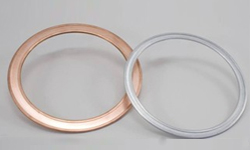
In high-vacuum systems, the leak rates are measured in helium molecules. You aren't just sealing liquid; you are sealing against ambient air rushing in. The specific bolt torque procedure here is designed to create a defined surface bite. If torque is too low, the metal jacket doesn't fill the microscopic flange scratches. If torque is too high, the jacket plastically bends and bridges the imperfections without actually sealing them—a phenomenon called "bridging." The procedure is designed to maintain the exact yield stress on the soft metal, often aluminum or copper jackets, to achieve a virtual leak-tight seal.
Why Installation Standards Matter: A Friction Coefficient Case Study
We often witness a disconnect between procurement specs and field execution. A plant manager orders a high-spec Nimonic alloy jacketed gasket, yet the flange finish is raided, and the bolt lube is inconsistent. The real-world pain is when the best material fails due to assembly ignorance. The torque procedure for a double jacket gasket must compensate for assembly friction. This table illuminates how drastically torque must be adjusted based solely on the bolt lubrication state:
| Bolt Condition | Nut Factor (K) | Required Torque (M20, 50kN Clamp) | Result of Miscalculation |
|---|---|---|---|
| Dry Carbon Steel | 0.20 | 200 Nm | Risk of galling, inaccurate load |
| Lubricated (Moly Paste) | 0.13 | 130 Nm | Best practice (low scatter) |
| Plated PTFE Coat | 0.09 | 90 Nm | Danger of over-torque if unadjusted |
Applying dry-torque values to lubricated bolts will instantly overload a Kammprofile or double jacket configuration. Ningbo Kaxite Sealing Materials Co., Ltd. mitigates this risk at the supply chain level. Our engineering reports, which ship with every critical-service gasket batch, define the clamp load target, not just the torque. We shift the conversation from "how tight" to "how much force," solving the disconnect between design engineering and field maintenance, ensuring a leak-free start-up.
Partnering for Zero-Leak Performance
Expert technical support turns a standard component into a reliability solution. With a deep understanding of the physics behind bolted joints, Ningbo Kaxite Sealing Materials Co., Ltd. serves as a vital resource for industrial buyers who refuse to compromise on safety. Our mission is to demystify complex torque requirements and provide sealing products that withstand extreme chemical and thermal challenges. For detailed engineering consultation, gasket selection, or custom torque calculations, connect with our specialists at [email protected]. Explore our full range of high-integrity sealing solutions and technical resources at Ningbo Kaxite Sealing Materials Co., Ltd., your trusted partner in industrial sealing integrity.
References
Bickford, J. H. (2007). *An Introduction to the Design and Behavior of Bolted Joints*. CRC Press, 4th Edition.
Nagy, A. (2011). "Analysis of Relaxation in Graphite-Filled Double Jacket Gaskets." *International Journal of Pressure Vessels and Piping*, 88(5), 212-218.
Bouzid, A. H., & Nechache, A. (2012). "Creep Modeling of PTFE-Based Gasket Materials." *ASME Journal of Pressure Vessel Technology*, 134(6).
Brown, W. (2009). "The Role of Bolt Load Scatter in Gasket Failure." *Sealing Technology*, 2009(12), 7-11.
Marchand, L., & Derenne, M. (2002). "Long-Term Tightness of Bolted Flanged Connections." *WRC Bulletin*, 473.
Winter, J. R. (2015). "Correlating Torque and Tension in Industrial Flange Assembly." *Chemical Engineering Progress*, 111(8), 34-40.
Kockelmann, H. (2010). "Leak Tightness Assessment of Heat Exchanger Gaskets." *Proceedings of the ASME Pressure Vessels and Piping Conference*, PVP2010-25845.
Zerres, H., & Guérout, Y. (2008). "Procedures for Bolted Joint Assembly in Nuclear Applications." *Nuclear Engineering and Design*, 238(7), 1702-1715.
Rino, J. A. (2013). "Friction Factors in Bolted Flange Connections: Impact on Gasket Stress." *Tribology International*, 67, 90-99.
Sato, Y., & Takeda, K. (2017). "Numerical Analysis on the Sealing Behavior of Double Jacketed Gaskets." *ISIJ International*, 57(10), 1821-1827.