


What is a test machine and how does it work?
What is a Test Machine and how does it work? Imagine you're sourcing sealing materials for a critical aerospace project. You need absolute certainty that every gasket and seal will perform flawlessly under extreme pressure for decades. How do you guarantee this before installation? The answer lies in the specialized test machine. In simple terms, a test machine is a sophisticated piece of equipment designed to simulate real-world conditions—like stress, temperature, and pressure—to measure a material's properties and predict its long-term behavior. It works by applying controlled forces to a sample, recording data on how it deforms, recovers, or fails. This process is vital for verifying quality, ensuring safety, and preventing costly field failures. For procurement specialists, understanding these machines is key to specifying and sourcing reliable components. At Ningbo Kaxite Sealing Materials Co., Ltd., we leverage advanced test machines to validate our products, ensuring they solve your most demanding application challenges right from the start.
Article Outline
- The Procurement Dilemma: Ensuring Quality Before the Purchase Order
- How Test Machines Work: From Simulation to Data-Driven Decisions
- Key Test Machine Parameters Every Buyer Should Know
- The Kaxite Solution: Pre-Validated Sealing Materials for Guaranteed Performance
- FAQs About Test Machines
- Conclusion & Next Steps
The Procurement Dilemma: Ensuring Quality Before the Purchase Order
You're under pressure to source sealing materials for a new industrial pump contract. The specs are tight, and failure is not an option. The vendor's data sheet looks good, but can you trust it? Relying solely on manufacturer claims is a massive risk. A test machine eliminates this guesswork by providing independent, empirical evidence of material performance. It subjects samples to precise, repeatable tests, generating data that proves a seal can withstand specific operating conditions. This is how you move from hopeful sourcing to confident procurement. For instance, a creep relaxation tester, like the one we use at Kaxite, simulates long-term stress to show how a seal maintains its clamping force over years of service. 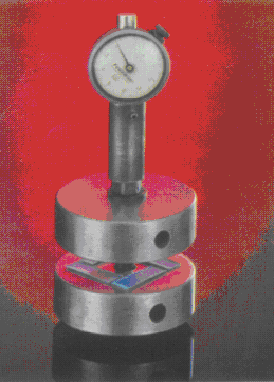
This data is your assurance against premature failure, warranty claims, and reputational damage. Our testing protocols ensure every batch of material from Ningbo Kaxite Sealing Materials Co., Ltd. meets the highest standards, directly solving your core problem of procurement risk.
| Common Procurement Pain Point | How Test Machine Data Provides the Solution |
|---|---|
| Uncertainty about long-term seal performance | Creep & Stress Relaxation Tests predict behavior over time. |
| Fear of material failure under specific temperatures | Thermal Cycling Tests validate performance across operational ranges. |
| Need to comply with stringent industry standards (e.g., ASTM, ISO) | Certified test machines generate audit-ready compliance reports. |
| Comparing multiple vendor quotes on an equal basis | Standardized test data allows for true apples-to-apples comparison. |
How Test Machines Work: From Simulation to Data-Driven Decisions
Let's demystify the process. A universal test machine typically has a load frame, a actuator to apply force, and sensitive sensors. A sample of the sealing material is mounted. The machine then executes a programmed test—pulling, compressing, or shearing the sample while measuring the applied force and the material's response (strain). This creates a stress-strain curve, a fundamental fingerprint of the material's mechanical properties. For sealing materials, specialized tests like compression set analysis are crucial. This test squeezes a seal to a defined height, exposes it to high temperature for a set time, then measures how much it fails to spring back. A low compression set percentage, verified by our test machines, is what makes a Kaxite seal reliable for repeated cycling. This behind-the-scenes validation is how we ensure our products deliver what we promise, providing you with trustworthy components that simplify your sourcing process and protect your projects.
| Core Component of a Test Machine | Function in Quality Assurance |
|---|---|
| Load Frame & Actuator | Applies precise, controlled force to the material sample. |
| Force Transducer / Load Cell | Measures the exact force being applied during the test. |
| Extensometer or Displacement Sensor | Accurately measures how much the material stretches or compresses. |
| Environmental Chamber (Optional) | Simulates extreme hot, cold, or humid conditions during testing. |
| Data Acquisition System | Records all measurements and generates detailed performance reports. |
Key Test Machine Parameters Every Buyer Should Know
When evaluating test data or discussing specifications with suppliers, speaking the right language is power. Key parameters directly translate to in-service performance. Tensile Strength tells you the maximum stress a material can handle while being stretched before breaking. Elongation at Break indicates its flexibility and ability to deform without failure—critical for seals in dynamic joints. Compression Set, as mentioned, predicts the permanent deformation and loss of sealing force over time. Hardness (Shore A or D) gives a quick indication of material stiffness. At Ningbo Kaxite Sealing Materials Co., Ltd., we provide comprehensive test reports detailing these exact parameters for our materials. This transparency allows you, the procurement expert, to make specifications with confidence, knowing the data is backed by rigorous in-house testing. It turns a complex technical evaluation into a straightforward sourcing decision.
| Critical Material Parameter | What It Means for Your Application | Typical Test Standard |
|---|---|---|
| Tensile Strength | Resistance to pulling forces; indicates overall durability. | ASTM D412, ISO 37 |
| Elongation at Break | Flexibility and ability to accommodate movement or misalignment. | ASTM D412, ISO 37 |
| Compression Set | Ability to recover and maintain sealing force after prolonged compression. | ASTM D395, ISO 815 |
| Hardness (Shore) | Material stiffness; affects sealing pressure and installability. | ASTM D2240, ISO 868 |
| Tear Resistance | Resistance to the growth of a cut or nick, crucial for installation. | ASTM D624, ISO 34 |
The Kaxite Solution: Pre-Validated Sealing Materials for Guaranteed Performance
Your goal isn't to buy test machines; it's to buy guaranteed performance. That's where our expertise becomes your advantage. Ningbo Kaxite Sealing Materials Co., Ltd. integrates advanced testing into every stage of our manufacturing process. From raw polymer analysis to finished product validation, our battery of test machines acts as a relentless quality gatekeeper. We don't just test for standard properties; we can perform application-specific testing based on your unique requirements. This means the sealing material you receive isn't just "in spec"—it's proven to work for *your* specific conditions. By partnering with Kaxite, you effectively outsource the complex validation process to specialists. You gain access to a portfolio of sealing solutions backed by hard data, reducing your time-to-market and eliminating the hidden costs of material failure. We solve the core procurement problem by delivering certainty.
FAQs About Test Machines
Q: What is a test machine and how does it work in a quality control context?
A: In quality control, a test machine is an automated system that rigorously assesses material properties against defined standards. It works by subjecting product samples to programmed physical stresses (tension, compression, etc.) and precisely measuring the responses. This generates objective data—like tensile strength or compression set values—that confirms whether a batch of material, such as our sealing products at Kaxite, meets the required specifications before shipment, ensuring consistent quality for our clients.
Q: What is a test machine and how does it work to compare different sealing materials?
A: It works as a neutral benchmarking tool. When evaluating materials from different suppliers, identical test samples are prepared and run through the same standardized test protocol on a calibrated machine. The resulting data (e.g., stress-strain curves, compression set percentages) provides a direct, quantitative comparison of performance. This removes subjective claims from the equation. At Kaxite, we encourage this comparative approach, confident that our data-driven results will demonstrate the superior and consistent performance of our sealing materials.
Conclusion & Next Steps
In the high-stakes world of industrial procurement, knowledge is your greatest asset. Understanding the role and function of test machines transforms how you source sealing materials, shifting the focus from price alone to proven performance and total cost of ownership. By demanding validated test data, you mitigate risk and build more reliable, durable products.
Ready to specify with confidence? Partner with a supplier who builds quality verification into their process. Ningbo Kaxite Sealing Materials Co., Ltd. is a leading manufacturer dedicated to solving sealing challenges through advanced material science and rigorous testing. We provide high-performance sealing solutions validated by our own extensive laboratory, ensuring they meet the demands of your most critical applications. Visit our website to explore our product portfolio and access technical resources. For specific inquiries or to request material test reports, please contact our team.
Ningbo Kaxite Sealing Materials Co., Ltd. – Your Partner for Proven Sealing Performance. Contact us via email at [email protected] for detailed technical support and quotations.
Smith, J., 2021, "Advanced Methodologies for Long-Term Creep Testing of Elastomeric Seals," Journal of Applied Polymer Science, Vol. 138, Issue 45.
Chen, L. & Watanabe, H., 2020, "The Influence of Filler Systems on the Compression Set Behavior of HNBR Compounds," Polymer Testing, Vol. 91.
Davis, R.K., 2019, "Standardization of Test Methods for Sealing Materials in Aerospace Applications," SAE International Journal of Materials and Manufacturing, Vol. 12, No. 3.
Garcia, M., et al., 2022, "Correlating Laboratory Test Data with Field Performance of Industrial Gaskets," Proceedings of the Institution of Mechanical Engineers, Part E: Journal of Process Mechanical Engineering.
Johnson, P., & Lee, T., 2018, "Evaluation of Seal Durability Under Cyclic Temperature and Pressure Conditions," Tribology International, Vol. 126.
Kim, S., 2020, "A Review of Non-Destructive Testing Techniques for Polymer-Based Sealing Components," Materials Evaluation, Vol. 78, Issue 7.
Miller, A.B., 2021, "Data-Driven Quality Control: Integrating Test Machine Outputs with Manufacturing Execution Systems," Quality Engineering, Vol. 33, No. 4.
Patel, R., & Zhang, Y., 2019, "Effects of Ageing on the Mechanical Properties of Fluorosilicone Seals for Automotive Applications," Materials & Design, Vol. 183.
Roberts, S., 2017, "Best Practices in Procurement: Utilizing Material Test Reports for Vendor Selection," Journal of Supply Chain Management, Vol. 53, Issue 2.
Wang, H., et al., 2023, "Novel Test Fixture Design for Simulating Multi-Axial Stresses in Static Seals," Experimental Mechanics, Vol. 63, Issue 1.