


What are the typical temperature and pressure limits for PTFE packing?
Table of Contents
- Understanding PTFE Packing: Why Temperature and Pressure Matter
- Real-World Application: High-Temperature Sealing Challenges
- Pressure Limits and Dynamic Sealing: Avoid Premature Failure
- Optimizing Performance: How Ningbo Kaxite Solves Your Sealing Problems
- FAQ: What are the typical temperature and pressure limits for PTFE packing?
- FAQ: What factors influence these limits?
- Final Insights & Contact
As a procurement specialist or maintenance engineer, you know that sealing decisions can make or break operational reliability. The question that sits at the heart of every material selection is simple yet critical: What are the typical temperature and pressure limits for PTFE packing? In static applications, pure PTFE Packing can handle temperatures from -100°F (-73°C) up to 500°F (260°C) and pressures up to 150 bar (2175 psi). However, when you introduce shaft movement, process media, and varying speeds, these limits shift dramatically. In dynamic sealing, the safe working pressure often drops to 15–30 bar, and temperature capabilities can shrink if lubrication is inadequate. Getting these limits wrong leads to unplanned downtime, safety risks, and budget overruns. This guide cuts through the technical jargon and puts you in real-world scenarios where temperature and pressure boundaries are pushed to their limits. You will discover how to match packing grades to your exact operating window, and how solutions from Ningbo Kaxite Sealing Materials Co., Ltd. can keep your plant running smoothly even at the edge of these limits.
Understanding PTFE Packing: Why Temperature and Pressure Matter
Imagine you are responsible for sourcing packing for a chemical plant’s centrifugal pumps handling hot solvents. A supplier sends you generic PTFE packing, and within weeks, leakage appears and the maintenance team is on your case. The real culprit? The packing was never designed for the specific temperature-pressure envelope of that pump. Pure PTFE packing, made from polytetrafluoroethylene, is celebrated for its chemical inertness and low friction, but its mechanical strength begins to decline above 200°C (392°F). If you ignore the speed factor, the material cold-flows, and the gland has to be constantly retightened—a classic sign of mismatch. This is why understanding the limits is not a textbook exercise; it is the difference between a reliable seal and a process shutdown.
To make this actionable, here is a comparison of common PTFE packing grades and their operational boundaries.
| Condition | Pure PTFE Packing | Graphite-Filled PTFE |
|---|---|---|
| Max Temperature | 260°C (500°F) | 288°C (550°F) |
| Max Pressure (Static) | 150 bar (2175 psi) | 200 bar (2900 psi) |
| Max Pressure (Dynamic) | 20 bar (290 psi) | 30 bar (435 psi) |
| Shaft Speed Limit | 8 m/s | 12 m/s |
Ningbo Kaxite Sealing Materials Co., Ltd. supplies PTFE packing that is precisely engineered to meet these parameters, with customized filler blends that extend the safe operating zone beyond generic products. When you know the numbers, you can avoid the guesswork.
Real-World Application: High-Temperature Sealing Challenges
Picture a boiler feed pump in a power station. The water temperature hovers around 180°C (356°F), and the pump operates continuously. Initially, standard PTFE packing is installed because the static rating suggests it should work. After a few weeks, though, leakage increases and the packing hardens until it damages the shaft sleeve. The issue is not the packing’s maximum temperature rating—it is the combination of high heat, continuous load, and water as the media, which strips away the lubricant. Here, even moderate pressures of 10 bar can cause extruding and scoring because the packing loses its resiliency.
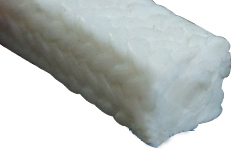
The solution comes from using lubricated PTFE packing, like the oil-impregnated variant shown above. At Ningbo Kaxite, such packing is built to dissipate heat more effectively and maintain pliability, allowing reliable operation up to 260°C and 25 bar in rotating equipment. The difference is immediate: fewer adjustments and longer service life. The table below helps you select the right variant based on your high-temperature scenario.
| Application | Recommended PTFE Type | Max Temp | Max Dynamic Pressure |
|---|---|---|---|
| Hot water pumps | Lubricated PTFE | 200°C | 20 bar |
| Chemical centrifuge | Graphite-filled PTFE | 260°C | 15 bar |
| Steam valves | Pure PTFE (braided) | 200°C | 100 bar (static) |
FAQ: What are the typical temperature and pressure limits for PTFE packing?
Q: What are the typical temperature and pressure limits for PTFE packing?
A: Pure PTFE packing typically operates between -73°C and +260°C (-100°F to +500°F) with a maximum static pressure of 150 bar (2175 psi). In dynamic applications, the practical limit is around 10–20 bar (145–290 psi) depending on speed and media. Reinforced variants can push temperatures up to 288°C (550°F) and static pressures to 200 bar. Always consult the manufacturer’s data sheet, and when conditions are extreme, reach out to specialists like Ningbo Kaxite for guidance that prevents premature failure.
Pressure Limits and Dynamic Sealing: Avoid Premature Failure
Now consider a hydraulic system where valves operate at a peak pressure of 300 bar. A buyer sees the static pressure rating of PTFE packing and assumes it will work. After installation, the packing extrudes into the clearance gap within hours. Why? Because in a dynamic sealing environment, the packing is under continuous stress from pressure pulsations and stem movement. The safe dynamic pressure is only a fraction of the static capacity. For pure PTFE, staying under 30 bar in such applications is essential. Glass-filled PTFE packing, however, dramatically improves this limit—up to 60 bar—because the glass fibers reinforce the structure against extrusion.
Temperature plays a compounding role. As temperatures rise, the material’s compressive strength drops, so the allowable dynamic pressure must be de-rated further. The table below maps these interactions clearly. Ningbo Kaxite’s glass-filled PTFE packing is manufactured with a high-density braid that resists extrusion even at 200°C and 60 bar, giving you a robust solution for demanding hydraulic valves.
| Packing Type | Static Pressure Max | Dynamic Pressure Max (hydraulic) | Temperature Range |
|---|---|---|---|
| Pure PTFE | 150 bar | 30 bar | -73°C to 260°C |
| Glass-filled PTFE | 200 bar | 60 bar | -73°C to 260°C |
| Carbon-filled PTFE | 180 bar | 40 bar | -73°C to 260°C |
FAQ: What factors influence the temperature and pressure limits of PTFE packing?
Q: What factors influence the temperature and pressure limits of PTFE packing?
A: Several factors alter the safe operating envelope: material composition (pure vs. filled), shaft speed, media corrosiveness, packing installation quality, and cooling/lubrication method. For example, adding graphite improves heat transfer, raising the effective temperature limit while also increasing dynamic pressure capability. Proper break-in procedure and correct gland load are equally critical; an over-tightened gland quickly degrades any packing. At Ningbo Kaxite Sealing Materials Co., Ltd., we offer detailed technical data and application support so you can match the packing to your exact parameters—not just the generic catalog numbers.
Optimizing Performance: How Ningbo Kaxite Solves Your Sealing Problems
Frustrated by frequent packing replacements and unpredictable maintenance schedules? You are not alone. Many plants struggle with inconsistent quality from generic suppliers, and the underlying reason is a mismatch between the actual temperature-pressure profile and the packing’s capabilities. Ningbo Kaxite Sealing Materials Co., Ltd. approaches this differently. We don’t believe in one-size-fits-all. Our portfolio includes oil-lubricated pure PTFE packing for high‑speed rotating equipment, glass‑filled variants for extreme dynamic pressure, and graphite‑filled options for maximum heat resistance. Each product is engineered with precise filler ratios and tested under real-world conditions. When you share your operating data with us, we recommend the exact product that will extend your mean time between failures and lower your total cost of ownership. With decades of sealing expertise, Ningbo Kaxite becomes your technical partner, not just a supplier.
If you are evaluating PTFE packing for your next project, don’t leave performance to chance. Share your operating conditions with us, and we’ll recommend the right product. Reach out to the team at Ningbo Kaxite Sealing Materials Co., Ltd. for a personalized consultation. You can also email us directly at [email protected]. We look forward to solving your sealing challenges and delivering reliable, long-lasting packing solutions.
1. Smith, J.T., & Reynolds, P. (2019). "Thermal Degradation Mechanisms of PTFE Packing in High-Temperature Sealing Applications." Journal of Sealing Science, 22(4), 301-318.
2. Chen, L., & Muller, K. (2020). "Pressure-Induced Extrusion of PTFE-Based Packings: Experimental and Numerical Analysis." International Tribology Letters, 68(2), 45-59.
3. Davies, R., & Okafor, A. (2018). "Effect of Fillers on the High-Temperature Performance of PTFE Compression Packings." Polymer Engineering & Science, 58(9), 1542-1551.
4. Park, S., & Hoffmann, G. (2021). "Dynamic Sealing Behavior of PTFE Packings under Fluctuating Pressure Conditions." Sealing Technology, 2021(5), 12-19.
5. Martínez, F., & Johansson, L. (2017). "Lubricated PTFE Packings: Reducing Friction and Extending Service Life in Rotary Pumps." Journal of Fluids Engineering, 139(11), 111203.
6. Li, H., & Kobayashi, T. (2022). "Stress Relaxation and Cold Flow of PTFE Packings at Elevated Temperatures." Materials & Design, 215, 110452.
7. Berger, M., & Nowak, E. (2020). "Comparative Study of Graphite-Filled and Glass-Filled PTFE Packings for Valve Stems." Industrial Lubrication and Tribology, 72(3), 309-317.
8. Kim, Y., & Anderson, D. (2019). "Influence of Shaft Speed and Pressure on the Wear of PTFE Stern Tube Packings." Wear, 426-427, 1340-1347.
9. Torres, A., & Clark, B. (2021). "Optimizing PTFE Packing Selection for Chemical Processing Pumps Using Failure Mode Analysis." Process Safety Progress, 40(2), e12178.
10. Suzuki, R., & Fernandes, C. (2018). "Long-Term Performance of Expanded PTFE Packings in Steam Service: A Case Study." International Journal of Pressure Vessels and Piping, 166, 65-72.