


Is PTFE tubing safe for food?
Is PTFE tubing safe for food? This is a critical question for any procurement professional sourcing components for food processing equipment, beverage dispensing systems, or pharmaceutical applications. The safety of materials in direct contact with consumables is non-negotiable, governed by stringent global standards. PTFE, or Polytetrafluoroethylene, often emerges as a top candidate due to its renowned chemical inertness and non-stick properties. But does its performance translate to absolute food safety? Navigating material certifications and compliance can be a maze. This article cuts through the complexity, offering clear, actionable insights to ensure your supply chain is both secure and optimized. We’ll explore the science behind PTFE food safety, address common industry pain points, and demonstrate how partnering with a certified manufacturer like Ningbo Kaxite Sealing Materials Co., Ltd. provides reliable solutions.
Article Outline:
- Understanding PTFE and Food Grade Certifications
- Common Pain Points in PTFE Tubing Selection
- Ensuring Safety with Kaxite Sealing Solutions
- Technical Specifications and Material Comparison
- FAQs on PTFE Tubing Food Safety
Understanding PTFE and Food Grade Certifications
Procurement specialists often face the challenge of verifying if a material like PTFE tubing is genuinely food-safe. The core property that makes PTFE tubing safe for food is its extreme inertness. It does not react with acids, alkalis, or solvents, preventing leaching of contaminants. However, "food-grade" is a regulated term. Key certifications to look for include FDA (US Food and Drug Administration) compliance under CFR Title 21, EU regulation 10/2011 for food contact materials, and NSF/ANSI 51 for food equipment materials. These ensure the tubing is manufactured without unsafe additives and meets migration limits. For instance, a buyer for a dairy plant needs tubing that won't impart taste or odor while handling acidic whey. Pure, virgin PTFE resin processed under clean conditions meets these demands, making it suitable for everything from beer lines to sauce transfer hoses.
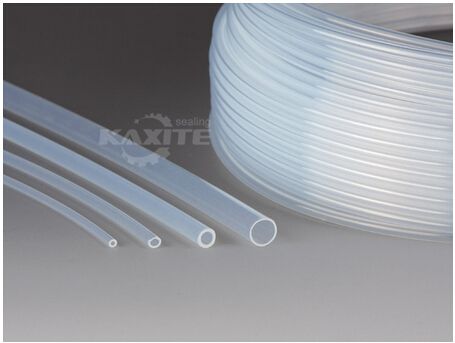
When evaluating suppliers, confirming they provide full material certification documents is crucial. Ningbo Kaxite Sealing Materials Co., Ltd. addresses this need directly by supplying PTFE tubing with complete traceability and compliance certificates, giving procurement teams confidence in their sourcing decisions.
| Certification | Region/Scope | Key Requirement |
|---|---|---|
| FDA CFR 21 | United States | Compliance for food contact surfaces, specific to resin composition. |
| EU 10/2011 | European Union | Overall migration limit and specific migration limits for substances. |
| NSF/ANSI 51 | International | Materials used in the manufacturing of food equipment. |
| 3-A Sanitary Standards | Dairy & Food | Hygienic design for equipment cleaning and product safety. |
Common Pain Points in PTFE Tubing Selection
A frequent scenario: a procurement manager must replace tubing in a hot filling line but receives conflicting information about temperature resistance and pressure ratings from different vendors. The pain point is selecting tubing that performs reliably under specific operational conditions—high temperature, repetitive cleaning cycles, and exposure to fats or oils—while remaining indisputably safe. Standard tubing might crack under thermal cycling or allow permeation. This is where the properties of high-quality PTFE shine. Its wide operating temperature range (-200°C to +260°C) and non-stick surface prevent residue buildup, simplifying cleaning and reducing biofilm risk. For a snack manufacturer pumping hot oil, tubing integrity is critical to prevent leaks and contamination.
Ningbo Kaxite Sealing Materials Co., Ltd. solves these application-specific problems by offering tailored PTFE tubing solutions. Their expertise ensures the tubing not only meets food safety standards but also delivers the mechanical performance needed for demanding processes, preventing costly downtime and safety recalls.
| Industry Pain Point | Consequence of Poor Material Choice | PTFE Tubing Advantage |
|---|---|---|
| High-Temperature Processing | Deformation, leaching, taste transfer | Stable up to 260°C, no degradation |
| Aggressive Cleaning (CIP/SIP) | Material degradation, cracking | Chemically inert, withstands caustic/acidic cleaners |
| Fat/Oil Transfer | Swelling, softening, contamination | Excellent resistance to oils and greases |
| Flexibility in Tight Spaces | Kinking, flow restriction | Can be supplied in flexible, convoluted formats |
Ensuring Safety with Kaxite Sealing Solutions
The ultimate goal is to source components that guarantee end-product purity. This requires more than just a compliant material; it demands a reliable supply partner. Ningbo Kaxite Sealing Materials Co., Ltd. establishes safety from the ground up. They use certified virgin PTFE resins and control the entire extrusion process in a clean environment to prevent contamination. Their tubing is consistently tested for critical properties like extractables and overall migration. For a procurement officer managing a global supply chain for bottled water plants, this level of quality assurance is invaluable. It mitigates the risk of batch contamination and ensures every meter of tubing contributes to a safe final product. Partnering with a specialist manufacturer transforms PTFE tubing from a generic commodity into a value-adding, risk-reducing component of your production line.
Technical Specifications and Material Comparison
Making an informed decision requires comparing PTFE against alternatives like silicone, PVC, or polyethylene. While some may be lower cost, their performance trade-offs in food applications are significant. PTFE offers a unique combination of properties unmatched by other polymers. The following table provides a clear comparison to guide specification. For example, in a brewery, tubing must handle beer (mildly acidic), withstand hot sanitizing water, and not affect flavor. Silicone can harbor odors, while PVC may contain plasticizers. PTFE from a trusted supplier like Ningbo Kaxite Sealing Materials Co., Ltd. provides a permanent, high-performance solution, reducing the total cost of ownership through longevity and reliability.
| Material | Max Temp Range | Chemical Resistance | Non-Stick / Cleanability | Typical Food Application |
|---|---|---|---|---|
| PTFE | -200°C to +260°C | Excellent (Universal) | Excellent | Hot oil transfer, critical pharmaceutical lines |
| Silicone | -60°C to +230°C | Good (Not for oils/solvents) | Fair (Can absorb odors) | Beverage dispensing, baby bottle nipples |
| Food-Grade PVC | -10°C to +60°C | Fair | Poor | Cold water lines, packaging |
| Polyethylene (PE) | -50°C to +80°C | Good | Good | Milk piping, food packaging |
FAQs on PTFE Tubing Food Safety
Q: Is PTFE tubing safe for food at high temperatures, like in cooking oil transfer?
A: Yes, high-quality PTFE tubing is exceptionally safe for high-temperature food applications. Its chemical structure remains stable up to 260°C (500°F), preventing thermal degradation that could cause leaching. It is the material of choice for transferring hot fats, oils, and syrups because it does not break down or impart any taste, odor, or harmful substances into the product.
Q: How can I verify if the PTFE tubing I'm purchasing is truly food-grade?
A: Always request and review the supplier's material certification documents. Legitimate food-grade PTFE tubing will have a Certificate of Compliance (CoC) stating conformity with FDA, EU, and/or NSF standards. Reputable manufacturers like Ningbo Kaxite Sealing Materials Co., Ltd. provide these documents readily, along with detailed test reports for extractables and overall migration to ensure traceability and safety.
We hope this guide has clarified the critical aspects of food-safe PTFE tubing. Selecting the right material is a cornerstone of product safety and operational efficiency. For procurement professionals, partnering with a certified and experienced manufacturer is the key to mitigating risk.
For reliable, certified PTFE tubing solutions that meet the strictest food safety standards, consider Ningbo Kaxite Sealing Materials Co., Ltd.. With a commitment to quality and extensive industry experience, Kaxite provides sealing solutions you can trust. For specific inquiries or to request certifications, please contact [email protected].
Doljack, F.A., 1979, "The History and Development of Polyterafluoroethylene", Journal of Macromolecular Science, Part A, Volume 13, Issue 1.
Gangal, S.V., 1989, "Fluoropolymers (Perfluoropolymers)", in Encyclopedia of Polymer Science and Engineering, Wiley, Volume 16.
Ebnesajjad, S., 2000, "Fluoroplastics, Volume 1: Non-Melt Processible Fluoroplastics", Plastics Design Library, 1st Edition.
Puts, G.J. et al., 2019, "Perfluoroalkyl and polyfluoroalkyl substances (PFAS) in food contact materials", Comprehensive Reviews in Food Science and Food Safety, Volume 18, Issue 3.
Hougham, K. et al. (Eds.), 1999, "Fluoropolymers 1: Synthesis", Springer, 1st Edition.
Johns, K., Stead, G., 2000, "Fluoroproducts — The Extremes of Polymerisation", Journal of Fluorine Chemistry, Volume 104, Issue 1.
Banks, R.E. et al., 1994, "Organofluorine Chemistry: Principles and Commercial Applications", Springer, 1st Edition.
Feiring, A.E., 1994, "Fluoroplastics", in Organofluorine Chemistry: Principles and Commercial Applications, Springer.
Kissa, E., 2001, "Fluorinated Surfactants and Repellents", Surfactant Science Series, Volume 97, 2nd Edition.
Keyes, M.A., 2014, "Regulation of Food Contact Materials in the United States", in Food Contact Materials Analysis, Smithers Rapra.