


What are the main applications of PTFE micropore gas filters?
What are the main applications of PTFE Micropore Gas filters? If you work in procurement for pharmaceutical, semiconductor, food, or chemical processing, this question likely appears in your supplier evaluation checklist more often than any other filter media query. PTFE micropore gas filters are used to remove particles, bacteria, and moisture from air and process gases while withstanding aggressive solvents, high temperatures, and repeated sterilization cycles. Because the polytetrafluoroethylene membrane is naturally hydrophobic, it stops aqueous liquids from passing while allowing clean gas to flow. That unique behavior solves contamination problems in fermenter venting, autoclavable gas lines, aggressive chemical sparging, and analytical instrument protection. Yet many buyers still struggle with pore size selection, flow drop, and long-term compatibility. Ningbo Kaxite Sealing Materials Co., Ltd. designs these filters to match real operating conditions, so you do not have to compromise between cleanliness and throughput. In this guide, we break down the main uses, the pain points behind each application, and the parameters that matter when comparing suppliers.
Contents
1. Sterile Gas Venting in Pharmaceutical and Biotech Lines2. Semiconductor and Electronics Process Gas Filtration
3. Chemical Processing and Acid Gas Lines
4. Food and Beverage Aeration and Carbonation
5. Laboratory and Analytical Gas Systems
6. How to Select the Right PTFE Micropore Gas Filter
7. Frequently Asked Questions on PTFE Micropore Gas Filters
1. Sterile Gas Venting in Pharmaceutical and Biotech Lines
Picture a fermentation suite at 3 a.m. The batch is at peak oxygen uptake, and the exhaust line begins to whistle. A low-cost vent filter has wetted out, liquid droplets have blocked pores, and tank pressure is rising. This scene leads to batch contamination or pressure release failure. In biopharma, sterile gas venting on bioreactors, media vessels, and autoclave air inlets must remain dry and bacteria-retentive. The solution is a hydrophobic PTFE micropore gas filter with a 0.22 µm pore rating. It allows continuous gas exchange while blocking bacterial ingress. At Ningbo Kaxite Sealing Materials Co., Ltd., we supply filters with high bubble point values and steam-stable construction, so SIP cycles do not deform the membrane.
Typical parameters for this application:
| Parameter | Specification |
|---|---|
| Membrane material | Hydrophobic PTFE |
| Pore size | 0.22 µm |
| Bacterial retention | ≥ 10⁷ CFU/cm² (Brevundimonas diminuta) |
| Water intrusion pressure | ≥ 0.35 MPa |
| Steam sterilization | 121–135 °C, 30–60 min per cycle |
This combination reduces false alarms and unplanned downtime. Procurement teams can compare this table directly with supplier datasheets instead of relying on vague “sterile-grade” claims.
2. Semiconductor and Electronics Process Gas Filtration
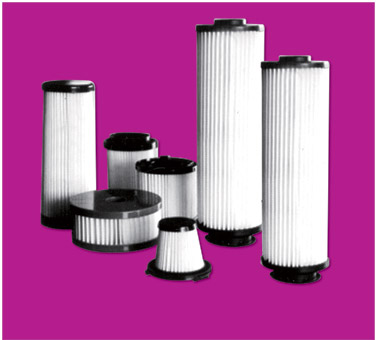
In semiconductor fabs, particle counts in CDA or nitrogen lines determine wafer yield. A single 0.1 µm particle on a photomask can scrap a lot. Conventional polypropylene filters shed fibers and cannot tolerate aggressive cleaning gases. PTFE micropore gas filters with 0.003–0.1 µm retention capture particles while resisting ozone, hydrogen peroxide, and amine-based gases. The image below shows a typical PTFE micropore gas element used in semiconductor gas panels.
Key parameters for semiconductor-grade gas filtration:
| Parameter | Typical value |
|---|---|
| Pore size | 0.003–0.1 µm |
| Particle retention | 99.9999% at rated pore size |
| Gas flow | High efficiency with low pressure drop |
| Outgassing | Low total hydrocarbon contribution |
| Chemical compatibility | Ozone, H₂O₂, HF, NH₃ |
By replacing short-lived polypropylene elements with all-PTFE construction, fabs reduce preventive maintenance frequency and avoid contamination events during tool startup.
3. Chemical Processing and Acid Gas Lines
Chlorine, sulfur dioxide, hydrogen chloride, and solvent vapors quickly degrade standard membranes. Leaks in filter housings or membrane collapse can lead to scrubber inefficiency and safety incidents. A maintenance team may notice a sudden drop in absorber performance and discover the filter media has become brittle. The solution is an all-PTFE micropore gas filter with no support leaching and a wide pH tolerance. Ningbo Kaxite Sealing Materials Co., Ltd. builds these elements with thermally bonded PTFE layers so the entire flow path resists aggressive gas streams from pH 1 to pH 14.
| Parameter | Specification |
|---|---|
| Chemical compatibility | pH 1–14, solvents, strong acids and bases |
| Maximum operating temperature | Up to 200 °C depending on hardware |
| Maximum differential pressure | 0.5 MPa at 20 °C |
| Air flow | High permeability per unit area |
| Construction | All-PTFE, no adhesive or metal in gas path |
This construction solves the classic trade-off between chemical resistance and mechanical strength. Buyers can specify one filter family for multiple acid gas lines instead of sourcing incompatible media for each process.
4. Food and Beverage Aeration and Carbonation
A brewery or dairy plant uses compressed air for sparging, blanketing, or product transfer. If the filter is hydrophilic, moisture condenses in the pores and bacteria can grow. The compressed air line then becomes a contamination source, causing off-flavors or failed microbial tests. The solution is a hydrophobic PTFE micropore gas filter rated 0.22 µm for sterile air and 0.45 µm for general venting. Hydrophobicity prevents water film formation, and the smooth membrane surface resists biofilm adhesion.
| Parameter | Recommended value |
|---|---|
| Pore size for sterile air | 0.22 µm |
| Pore size for general venting | 0.45 µm |
| Water penetration pressure | ≥ 0.30 MPa |
| Operating temperature | -20 °C to 150 °C |
| Compliance | FDA-compliant PTFE and support material |
With this setup, production lines maintain consistent carbonation levels and pass daily microbial sampling without extra sanitization downtime.
5. Laboratory and Analytical Gas Systems
Gas chromatographs, HPLC systems, and mass spectrometers need hydrocarbon-free, moisture-free carrier gas. A poor-quality filter causes baseline drift, column degradation, and false peaks. Analysts may spend hours troubleshooting an instrument when the real issue is a wetted or particle-loaded inlet filter. PTFE micropore gas filters remove fine particles, water aerosols, and some VOC contaminants while adding minimal pressure drop. Their low extractables profile ensures the filter does not introduce new interfering compounds into the analytical stream.
| Parameter | Specification |
|---|---|
| Outlet particle count | Zero particles ≥ 0.01 µm |
| Hydrocarbon contribution | Negligible, low extractables |
| Moisture removal | Hydrophobic barrier for water aerosols |
| Flow rate | High flow for carrier gas lines |
| End connections | Compression, NPT, or flange options |
Laboratory managers benefit from stable baselines and longer column life. Procurement can standardize on one PTFE micropore gas filter format for multiple instrument gas lines, reducing inventory complexity.
6. How to Select the Right PTFE Micropore Gas Filter
A purchasing manager often receives three quotes that look identical on paper: all say PTFE, all say 0.22 µm, all say high flow. The difference appears later, when one filter blocks early or its housing cracks during steam cycles. To avoid this, evaluate the following application-specific parameters before ordering. The table below compares common pore sizes and typical use cases.
| Pore size | Typical gas application | Retention target | Pressure drop |
|---|---|---|---|
| 0.1 µm | Semiconductor clean dry air, analytical carrier gas | Fine particles and aerosols | Moderate |
| 0.22 µm | Sterile venting, fermentation air, sterile air sparging | Bacteria and particles | Moderate to low |
| 0.45 µm | General venting, food/beverage tank vents | Yeast, molds, larger particles | Low |
| 1.0 µm | Prefiltration, coarse particle removal | Large particles, debris | Very low |
Always verify bubble point, water intrusion pressure, and autoclave stability. Ningbo Kaxite Sealing Materials Co., Ltd. provides third-party test data for each lot, so you can compare real performance instead of marketing promises.
7. Frequently Asked Questions on PTFE Micropore Gas Filters
Q: What are the main applications of PTFE micropore gas filters in high-purity industries?
A: The main applications include sterile gas venting on bioreactors and fermenters, process gas filtration in semiconductor fabs, acid gas and solvent vapor filtration in chemical plants, compressed air and carbonation gas treatment in food and beverage lines, and carrier gas protection in analytical laboratories. PTFE micropore gas filters are chosen because their hydrophobic membrane blocks water and bacteria while maintaining high gas flow and broad chemical compatibility.
Q: How can I confirm a specific filter is suitable for the main applications of PTFE micropore gas filters?
A: Check the membrane pore size, water intrusion pressure, bubble point, temperature rating, and end connection style. For sterile applications, request bacterial retention test data. For aggressive chemical gases, confirm all-PTFE construction with no adhesive or metal in the gas path. Ningbo Kaxite Sealing Materials Co., Ltd. can provide a selection matrix and test reports so your procurement decision matches the actual operating conditions.
Still comparing PTFE micropore gas filter suppliers for your next campaign? At Ningbo Kaxite Sealing Materials Co., Ltd., we help procurement and engineering teams match the right membrane, pore size, and hardware to the actual process gas — not just the cleanest datasheet. Send your operating conditions to [email protected] and we will return a shortlist with flow curves, compatibility data, and pricing.
1. Zhang, Y., Wang, L., & Li, J. (2021). Hydrophobic PTFE membrane performance for sterile gas venting in single-use bioreactors. Journal of Membrane Science, 627, 119254.
2. Baker, R. W., & Low, B. T. (2014). Gas and vapor separation through microporous PTFE membranes. Separation and Purification Technology, 121, 2–12.
3. Chen, H., Wu, X., & Zhao, Q. (2020). Pore size influence on aerosol retention in expanded PTFE gas filtration media. Separation and Purification Technology, 245, 116852.
4. Liu, M., Sun, Y., & Zhou, P. (2019). Chemical resistance of PTFE microporous membranes in acid gas filtration. Chemical Engineering Journal, 372, 356–365.
5. Park, S., Kim, J., & Lee, H. (2022). Low-outgassing PTFE filters for semiconductor cleanroom gas delivery systems. Journal of Industrial and Engineering Chemistry, 108, 225–233.
6. Rahman, M. A., & Sirkar, K. K. (2018). Hydrophobic membrane contactors for gas-liquid process intensification. Industrial & Engineering Chemistry Research, 57(22), 7456–7470.
7. Thomas, M. P., & Vane, L. M. (2021). PTFE membrane degradation under aggressive oxidative gas streams. Journal of Membrane Science, 638, 119701.
8. Nielsen, C. F., & Larsen, T. (2017). Sterile filtration of compressed air in food processing: A comparative study of PTFE and PVDF. Food and Bioproducts Processing, 102, 34–41.
9. Huang, Y., Zhang, T., & Feng, X. (2023). Bubble point and water intrusion pressure as quality indicators for hydrophobic PTFE filters. Journal of Aerosol Science, 168, 106331.
10. Santos, A. L., & Belfort, G. (2016). Surface modification of PTFE membranes for reduced protein fouling in gas venting applications. Polymers for Advanced Technologies, 27(5), 579–588.